Two COB LED quotes landed on my desk last year. One used Lumileds COB LED modules from the LUXEON family, with a full documentation package. The other promised “the same specs” at 22 percent less. Same 3000K CCT. Same 90 CRI claim. Nearly identical lumen output. On paper, the comparison was over before it started—for the lower price.
I’m the quality and compliance manager at a lighting manufacturer. We build LED panels, linear light bars, and under-cabinet lighting strips for commercial projects. My job is to review every component batch before it enters production—roughly 200 line items a year. In 2025 I’ve rejected just over 11% of first-article deliveries for spec drift. That cheaper COB LED quote is the reason I don’t trust datasheet comparisons anymore.
Why identical specs behave differently
It’s tempting to treat LEDs as interchangeable. Same CCT, same CRI, similar lumens, nearest price—done. If you’re a light bar manufacturer, the temptation is even stronger because the LED sits in an aluminum extrusion where heat has nowhere to go, and your margin is already thin.
The problem is where the specs come from. Most LED data is measured at a 25°C junction temperature, often with short test pulses that keep the chip cool. That’s a controlled laboratory condition, not an operating condition. Inside a typical LED panel or light bar, junction temperature sits somewhere around 85–105°C. At that temperature, light output drops, and the color point can shift.
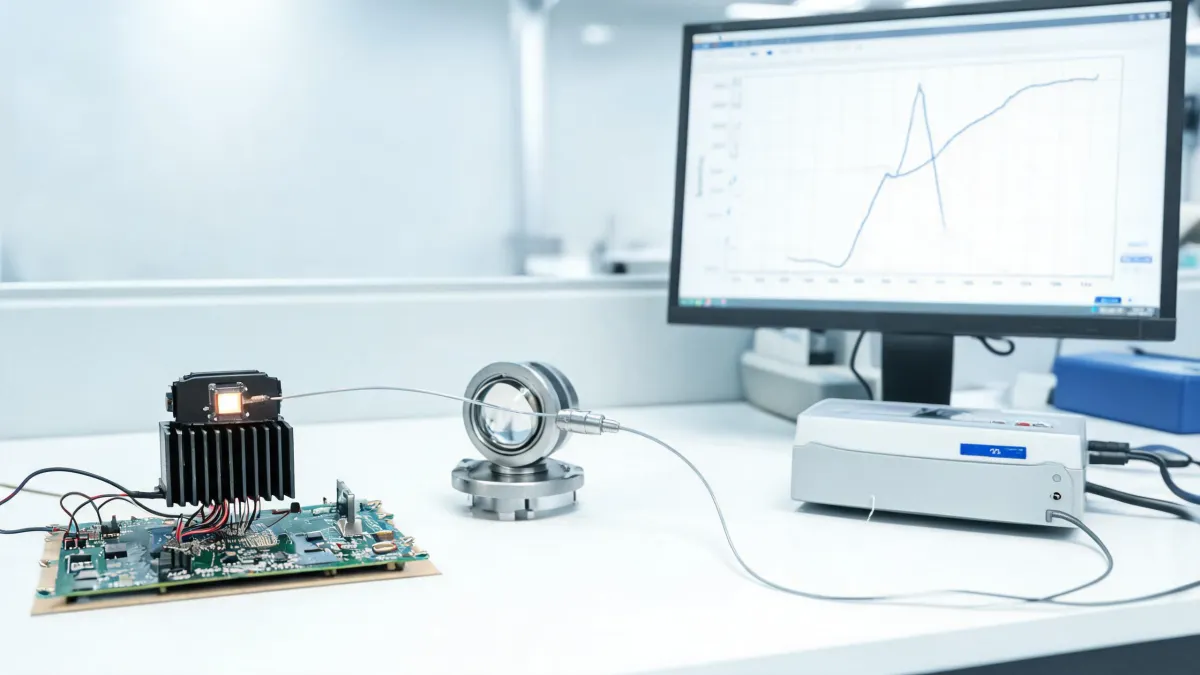
In our lab, the cheaper module looked fine at room temperature—within 2% of the Lumileds part. After everything warmed up, things changed. The cheaper module’s CCT crept from 3000K to roughly 3270K, and CRI slipped two points. It didn’t fail dramatically. It just quietly stopped being the product on the datasheet. And to be fair, the datasheet didn’t lie exactly—it just never promised behavior at the temperature we actually run.
The second problem is binning. A nominal 3000K is not one color; it’s a range of similar colors. Manufacturers sort LEDs into bins—some tight, some less tight. A quality package might specify a 3-step MacAdam ellipse, which is narrow enough that most people can’t see differences between adjacent fixtures. A looser sort can look fine in a single fixture and like a patchwork quilt across twenty of them.
We measured ten samples from the cheaper vendor’s first-article batch. The CCT range across those ten parts was around 480K. For context, our main approved LED lines hold to roughly 150K. I’ll be honest: I don’t have hard data on how the entire budget tier sorts its chips. But since 2021 we’ve rejected about 40 incoming batches, and 13 were tint-related. Every one of those 13 came from a supplier that couldn’t tell us its binning standard. I wish I’d tracked that metric from the beginning—hindsight is annoying like that.
Where the savings actually go
Let me put some numbers on it, because “quality is worth it” is just a slogan without math.
Say a cheaper LED saves $0.20 per module. On a 50,000-unit annual run, that’s a $10,000 saving. It feels real. But one field problem can erase it. On a school project last year, we delivered 1,800 LED panels. Around 350 of them drifted enough in tint that the general contractor rejected part of the install. We ended up swapping about 96 panels in a single corridor. Replacement product, truck rolls, electricians, and a rushed production slot came to roughly $14,600. The component saving on that project was $2,340—no, wait, $1,860; I remember signing the variance report. Either way, the saving disappeared and then some.
I see the same pattern in LED bulb sourcing. Samples pass. The first production run passes. Then the factory gets a different bin of emitters, and the second run leans visibly green or warm. For a distributor, that’s not a technical curiosity—it’s a SKU that doesn’t match itself across boxes. You don’t discover it until customers start comparing two bulbs at home and posting side-by-side photos.
And before someone accuses me of bashing low-cost suppliers as a category: I’m not. Some budget vendors do excellent binning control and give you honest data. The problem is that comparing two price lists doesn’t tell you which kind of supplier you’re actually dealing with.
This is also where the LED panel OEM vs private label decision matters more than people think. In a true OEM arrangement, the buyer can specify the emitter, the bin, and the thermal requirements. In a private-label arrangement, you’re usually putting your name on a manufacturer’s existing design. If that manufacturer swaps a component to improve margin or cover a shortage, the tint and longevity specs can change with it. Legally, responsibility may sit with the panel maker. Practically, the buyer’s logo is on the product, so the buyer absorbs the brand damage.
What I ask for before accepting a cheaper quote
I don’t have a rule like “never accept lower-cost alternatives.” I have a checklist. If a vendor can answer these, I’ll happily approve a less expensive source:
First, an LM-80 report and TM-21 projection for the exact part number and bin you’re quoting—not for the closest family member. Second, binning specified in the contract: a chromaticity bin or MacAdam ellipse. Third, thermal performance at your operating current and temperature, not just room-temperature numbers. Fourth, a written substitution policy that says the supplier will not change the BOM without approval. If your quote is for a private-label product, the substitution clause matters even more.
This is how we ended up standardizing many new designs on Lumileds LED parts. It wasn’t because Lumileds is the only good emitter brand. It’s because when we test incoming Lumileds LED parts, the measured performance matches the documentation—and the documentation includes binning, LM-80/L90 data, and lot traceability. For someone in my role, that consistency is the product. After roughly a year of running our main panel and light bar lines on Lumileds COB LED modules, the first-article rejection rate for those product families dropped from about 9% to under 2%. Field tint complaints basically disappeared. One caveat: we did have a driver-related issue that we initially blamed on the LEDs. It wasn’t them. The driver’s current ripple was interacting with the module. So no, switching brands doesn’t make you immune to doing the work.
I still get challenged by procurement, and I don’t blame them. Lumileds isn’t the cheapest option in most categories. But my job isn’t to minimize unit cost; it’s to minimize the cost of the whole project—the one that includes rejections, rework, truck rolls, and standing in a school corridor explaining why your product doesn’t match.
If a cheaper component can prove itself through measured performance and solid data, I’ll take it. If it can only promise “same specs” on a PDF, the saving is just a risk that hasn’t turned into an invoice yet.
In LED sourcing, the most expensive quote is rarely the one with the highest price. It’s the one you never checked at operating temperature.